

Argentine Tegu Enclosure Setup: How to Build a Habitat for a Tiny Dinosaur With Demands
Because Your Murder Chicken Needs More Than a Tank, a Heat Lamp, and Your Blind Optimism

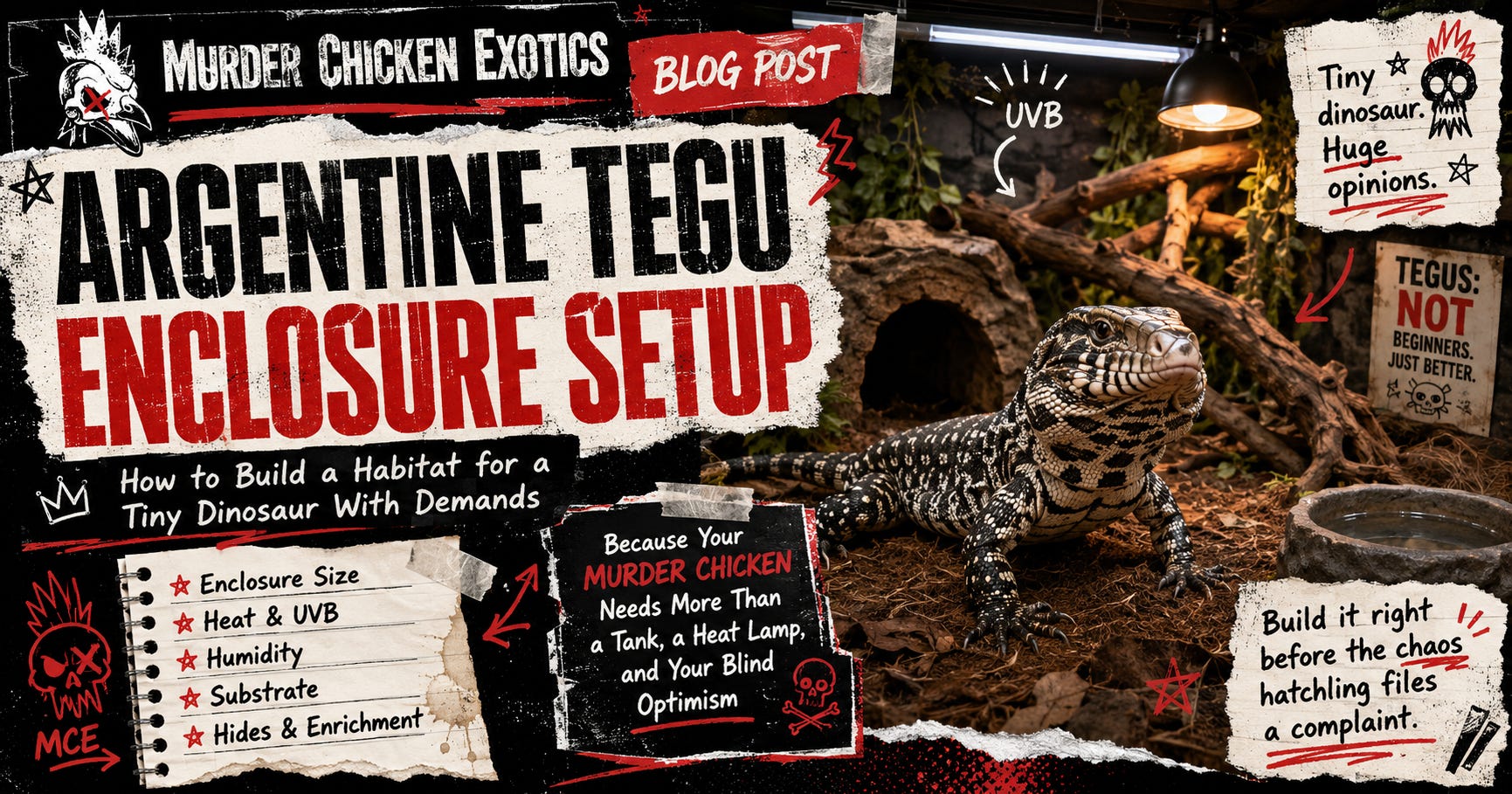
Argentine tegus are not small reptiles with small needs. They are large, intelligent, powerful, active lizards with the curiosity of a toddler, the appetite of a raccoon, and the ability to turn a badly planned enclosure into a very expensive lesson in humility.
A proper tegu enclosure is not just a box that keeps the lizard inside. It is the foundation of your animal’s health. The enclosure controls heat, humidity, UVB exposure, security, enrichment, exercise, digestion, shedding, and stress. When the habitat is wrong, everything else starts falling apart like a cheap lawn chair at a family reunion.
Argentine black and white tegus, Salvator merianae, are large, terrestrial, active-by-day lizards. In the wild, they use mixed grassland, woodland, forest edges, clearings, roadsides, and burrows or covered retreats for brumation and shelter. They are also strong swimmers and spend most of their time on or near the ground rather than climbing high into trees like tiny scaly acrobats with delusions of grandeur. (Georgia Wildlife)
That matters because a good tegu enclosure should support what tegus actually do: walk, dig, bask, hide, soak, explore, forage, thermoregulate, and occasionally act like the furniture personally offended them.
The Big Rule: Bigger Is Better
The first mistake many new keepers make is underestimating how much space a tegu needs. A baby tegu is adorable and manageable. An adult Argentine tegu is a muscular reptile suitcase with claws and opinions.
ReptiFiles recommends minimum adult enclosure sizes for Salvator merianae of 10 feet long x 5 feet wide x 5 feet high for males and 8 feet long x 4 feet wide x 4 feet high for females, while also strongly recommending more space whenever possible. (ReptiFiles®)
That is not “extra.” That is not “spoiled.” That is the cost of keeping a giant intelligent lizard responsibly.
A tegu enclosure needs enough space to allow movement, a real temperature gradient, deep substrate, multiple hides, a proper basking zone, a cooler retreat, humidity control, a water area, and enrichment. A cramped enclosure forces the animal into one tiny environmental condition and gives it no real choices. Reptiles need choices. They move between warm and cool areas, dry and humid areas, open and hidden spaces. If they cannot choose, they cannot regulate themselves properly.
A 4x2x2 setup might work briefly for a baby or juvenile, but it is not an adult home. It is a starter apartment. Your tegu is going to outgrow it faster than you emotionally prepared for.
Baby and Juvenile Tegu Enclosures
Baby tegus can start smaller than adults, but they still need room to explore, bask, hide, and dig. The goal is not to keep them in a tiny enclosure until one day you panic-build a giant cage because they suddenly look like a dinosaur that discovered protein.
For hatchlings and juveniles, choose an enclosure that is secure, escape-proof, front-opening if possible, and easy to monitor. Babies are nervous, fast, and dramatic. They need hides, humidity, proper heat, and security just as much as adults.
A young tegu setup should include:
A warm basking area, a cooler side, UVB lighting, deep enough substrate for digging, at least two hides, a humid hide, a water bowl, climbing and texture options, and enough visual cover that the baby does not feel like it has been placed in the reptile version of a Target parking lot.
The biggest thing is planning ahead. Tegus grow quickly. If you bring one home, the adult enclosure should already be part of the plan. “I’ll figure it out later” is how later becomes “why is there a lizard trying to renovate my drywall?”
Adult Tegu Enclosure Size
For an adult Argentine black and white tegu, the best habitat is a large, sturdy, front-opening enclosure with deep substrate, high humidity, strong overhead heat, UVB, ventilation, and multiple secure zones.
A good adult setup is usually custom-built or made from large PVC, sealed wood, or other humidity-safe materials. Glass tanks are generally a poor choice for adult tegus because they are too small, too exposed, poor at holding humidity, and often difficult to heat properly at the scale required.
A proper adult enclosure should give your tegu:
Enough floor space to walk and turn comfortably
A large basking zone that heats the whole body
A cool side where the animal can escape heat
Deep substrate for digging and burrowing
A humid hide or burrow-style retreat
Strong UVB and visible light
Sturdy hides, logs, shelves, and enrichment
A large water dish or tub
Secure doors and locks
Tegus are strong. They push. They dig. They test weak spots. They will find the one part of your enclosure that you built with optimism instead of screws.
Best Enclosure Materials
The best tegu enclosures are usually made from PVC, sealed plywood, or professionally built reptile enclosures designed for large lizards.
PVC is popular because it holds humidity well, is relatively easy to clean, and does not rot the way untreated wood can. Sealed plywood can also work beautifully if it is properly waterproofed and built strong enough to handle deep substrate, moisture, heat fixtures, and one lizard-shaped bulldozer.
Whatever material you use, the enclosure should be able to handle:
Humidity, daily misting, heavy substrate, digging, claws, heat lamps, water spills, deep bedding, and repeated cleaning.
Do not use untreated wood where it will be exposed to moisture. Do not use flimsy screen cages. Do not use a setup where the doors can be pushed open by a determined animal with the strength of a cursed lunchbox.
Locks matter. Sliding door locks, hasps, child locks, or reptile-safe latches are not overkill. They are how you avoid finding your tegu in the laundry room looking like it has joined a union.
Heating: Building the Right Temperature Gradient
Tegus are ectothermic, which means they rely on external heat to move, digest, and function properly. ReptiFiles recommends a tegu temperature gradient with a basking surface of 125–135°F, a warm side of 90–95°F, and a cool side of 75–85°F, with lights and heat turned off at night to allow a drop around 68–74°F. (ReptiFiles®)
That gradient is the whole point. Your tegu needs to be able to warm up and cool down by moving through the enclosure. If the whole enclosure is one temperature, you have not created a habitat. You have created a reptile crockpot or a sad lukewarm prison, depending on which direction you messed up.
The basking area should be large enough to heat the entire body. One tiny hot spot is not enough for a big lizard. A large tegu needs a wide basking zone, often created with multiple overhead halogen bulbs or flood bulbs arranged so the heat spreads across the animal’s body.
Use an infrared temperature gun to check surface temperatures. Stick-on analog thermometers are not enough. They are basically decorative lies with suction cups.
Also use digital thermometers and hygrometers on both the warm and cool sides. Measure the enclosure, do not guess. Reptiles do not care that the lamp “feels warm to you.” You are a giant mammal with poor judgment and a hoodie.
Heat Sources: What Works Best
Overhead heat is usually best for tegus because it mimics the sun and encourages natural basking behavior. Halogen flood bulbs are commonly used because they provide strong, penetrating heat and visible light. ReptiFiles notes that halogen and incandescent bulbs produce infrared-A, which penetrates animal tissue more efficiently than weaker forms of heat. (ReptiFiles®)
Avoid relying only on under-tank heaters, heat mats, or heat rocks. Tegus burrow, and heat from below can confuse natural thermoregulation. Heat rocks are especially risky because they can cause burns. If you need supplemental nighttime heat because your room drops too cold, use a reptile-safe ceramic heat emitter or radiant heat panel controlled by a thermostat.
Every heat source should be safely installed, protected from contact, and regulated when needed. Tegus are large enough to knock into fixtures, shove decor around, and generally act like they were raised by drunk demolition contractors.
UVB Lighting: Not Optional
UVB is one of the most important parts of a tegu enclosure. Reptiles use UVB exposure to synthesize vitamin D3, which helps them absorb and regulate calcium. Merck Veterinary Manual notes that poor diet, low calcium-to-phosphorus ratio, vitamin D3 deficiency, lack of UVB, and inadequate heat can contribute to metabolic bone disease in reptiles. (Merck Veterinary Manual)
In other words, calcium powder alone does not save you if the lighting and heat are trash.
Merck also notes that placing a heat bulb near the UVB bulb can help encourage lizards to get UVB exposure while basking, and that UVB bulbs lose output over time and should be replaced according to manufacturer directions or monitored with a UVB meter. (Merck Veterinary Manual)
For tegus, a high-quality linear T5 UVB fixture is usually preferred over compact coil bulbs because it provides better coverage. The UVB should cover part of the enclosure, especially the basking zone, while still allowing the tegu to move away from it. The animal should not be forced to sit under UVB all day with no escape.
UVB does not pass properly through glass or most plastics. Mesh can reduce output depending on the screen type and distance. Fixture placement matters. Bulb strength matters. Distance matters. Reflector quality matters. This is not the place to buy the cheapest mystery bulb from the “probably not haunted” section of the internet.
Visible Light and Day/Night Cycle
Tegus are active during the day, so they benefit from a clear day/night cycle. Georgia DNR describes Argentine black and white tegus as active by day, which means their enclosure should provide bright daytime lighting and darkness at night. (Georgia Wildlife)
A normal active-season light cycle is often around 12 hours on and 12 hours off, though some keepers adjust seasonally. Bright light helps support activity, basking, feeding response, and natural rhythms. If you are running a bioactive enclosure, full-spectrum LED or grow lighting also helps plants survive the daily assault of being trapped with a small dinosaur.
At night, lights should be off. Tegus need darkness. They do not need red bulbs, blue bulbs, moon bulbs, disco bulbs, or a nightclub enclosure aesthetic. Let the lizard sleep. It has a long day of digging holes and judging you tomorrow.
Humidity: Moist, Not Swamp Goblin
Argentine tegus need high humidity compared to many common pet reptiles. ReptiFiles recommends 70–80% humidity for tegus and suggests keeping substrate uniformly moist but not muddy, misting daily, and providing a humid hide with damp sphagnum moss kept around 90–100% humidity while replacing moss regularly to prevent mold. (ReptiFiles®)
Humidity supports healthy shedding, skin condition, hydration, and burrowing behavior. Too dry, and you may see stuck shed, dry skin, poor sheds, and dehydration issues. Too wet, and you can create mold, bacteria, scale problems, and respiratory concerns.
The substrate should feel damp below the surface but not soaked. If you squeeze a handful and water pours out, congratulations, you have created a bog. That is not husbandry. That is amphibian real estate.
Use digital hygrometers. Check humidity in multiple areas. The warm side may dry out faster than the cool side. Burrows and hides may hold moisture differently than open areas. A good enclosure creates options.
Substrate: Let Them Dig
Tegus dig. They burrow. They rearrange. They do not want a thin decorative sprinkle of bedding. They want enough substrate to behave like the tiny excavation goblins they are.
A good tegu substrate should hold humidity, allow digging, be safe if accidentally ingested in small amounts, and be easy to maintain. ReptiFiles lists a DIY naturalistic mix of roughly 40% organic topsoil, 40% coconut fiber, and 20% play sand, topped with leaf litter, as an option that holds humidity and burrows well when moistened. (ReptiFiles®)
Other common options include cypress mulch, coconut husk chips, coco fiber blends, soil/sand mixes, and bioactive-ready substrate systems. Avoid cedar and pine shavings, scented bedding, dry dusty substrate, cat litter, walnut shell, corn cob, reptile carpet, and anything with fertilizer, manure, perlite, vermiculite, pesticides, or weird mystery additives.
Depth matters. Juveniles should have enough substrate to dig and hide. Adults should have deep substrate where possible, especially in a designated burrowing area. If your enclosure cannot hold deep substrate, you need a substrate barrier, reinforced lower walls, or a better enclosure design.
Tegus are happiest when they can dig. Owners are happiest when the tegu digs in substrate instead of into the corner seam like it is tunneling out of prison with a spoon.
Hides and Burrows
A tegu enclosure should include at least two hides: one on the warm side and one on the cool side. A humid hide is also extremely useful. ReptiFiles recommends a cool humid hide lined with damp sphagnum moss to help maintain higher humidity for the animal. (ReptiFiles®)
For adults, hides need to be large, sturdy, and secure. A hide that moves every time the tegu touches it is not comforting. It is furniture betrayal.
Good hide options include large cork rounds, custom wooden hides, PVC hide boxes, half logs for juveniles, large plastic tubs modified safely, burrow boxes, and built-in underground-style retreats. The hide should be big enough for the tegu to enter, turn around, and settle comfortably.
The best hides feel dark and secure. Tegus are bold animals, but they still need privacy. A tegu that cannot hide properly may become stressed, defensive, or restless.
Water Dish or Soaking Tub
Tegus should have access to clean water at all times. Many tegus enjoy soaking, so a large sturdy water dish or tub can be helpful. The water container should be big enough for soaking if space allows, but not so deep that a young tegu struggles to exit.
Water bowls must be heavy or secured. Tegus are not gentle. They will climb into the dish, dig substrate into it, knock it sideways, poop in it, and then look at you like you are the maintenance staff. Which, unfortunately, you are.
Change water often. Clean the dish thoroughly. A dirty water bowl in a humid enclosure becomes a bacterial soup kitchen faster than anyone wants to admit.
Ventilation: Humid Does Not Mean Stagnant
A good tegu enclosure must hold humidity while still allowing airflow. This is one of the trickier parts of large reptile enclosure design. Too much ventilation and the enclosure dries out. Too little ventilation and the air becomes stale, wet, and gross.
PVC and sealed wood enclosures often need planned ventilation panels or vents. Front ventilation combined with upper rear ventilation can help air move while still retaining humidity. Screen tops can make humidity difficult to maintain, especially in dry homes, but fully sealed boxes can cause their own problems.
The goal is stable humidity with fresh air. Not desert. Not swamp. Not a haunted basement with scales.
Enrichment: Give the Brain Something to Do
Tegus are intelligent, curious animals. A barren enclosure is not enough. The Bio Dude notes that enclosure decor is not just aesthetic; it provides environmental enrichment by giving tegus opportunities to explore, exercise, and express natural behaviors. Suggested enrichment items include ledges, hollow logs, sturdy branches, hides, caves, and live plants. (The Bio Dude)
Enrichment does not have to be fancy. It has to be functional.
Good tegu enrichment ideas include:
Deep substrate for digging
Cork bark and logs
Large branches and ramps
Rocks or slate under the basking area
Scent trails
Puzzle feeders
Scatter feeding
Food hidden under leaves or in dig boxes
Safe supervised exploration
Water tubs
Seasonal enclosure rearrangements
Leaf litter
Different textures and terrain
Tegus are strong, so decor must be stable. Do not stack rocks in a way that can collapse. Do not use flimsy branches. Do not create tight spaces where the tegu can get wedged.
The goal is “enriched naturalistic habitat,” not “escape room designed by a negligent goblin.”
Basking Platform and Surface Choice
Your basking surface matters because it determines how heat is absorbed and distributed. Slate, stone, tile, pavers, or large flat rocks can work well under heat lamps because they absorb warmth and create a stable basking area. They should be secure, flat, and not able to shift or crush the tegu.
Do not use heat rocks. Do not use unstable rock piles. Do not place heavy basking stones directly on loose substrate where the tegu can dig underneath and collapse the whole thing like a tiny reptilian mining disaster.
If you use heavy decor, place it directly on the enclosure floor before adding substrate, or secure it so digging cannot undermine it.
Indoor vs Outdoor Enclosures
Indoor enclosures are easier to control. You can manage heat, humidity, lighting, security, and seasonal changes more predictably. For most keepers, a large indoor PVC or sealed wood enclosure is the safest long-term choice.
Outdoor enclosures can be excellent in the right climate, but they come with more risk. You have to consider local laws, weather, predators, flooding, escape-proofing, overheating, cold snaps, parasites, pesticides, and security. Tegus are strong diggers, so outdoor enclosures need buried barriers, solid walls, locked access, shade, dry retreats, water, and protection from both escape and predators.
Georgia DNR notes that tegus winter in burrows or under cover in a brumation-like state and use habitats including mixed grassland, woodlands, forest clearings, fence rows, and roadsides. (Georgia Wildlife) That tells us they are excellent at using cover and shelter. It also tells us a poorly secured outdoor enclosure is basically a “please leave and become everyone’s problem” invitation.
If you use outdoor time, supervise it unless the enclosure is truly escape-proof. A tegu loose in the neighborhood is not cute. It is a wildlife report with legs.
Bioactive Tegu Enclosures
Bioactive tegu enclosures can be beautiful and enriching, but they are not beginner-proof. Tegus are heavy, active, and destructive. They may uproot plants, crush clean-up crews, flood water areas, dig out hides, and generally treat your carefully designed ecosystem like a demolition derby with humidity.
A bioactive setup needs deep substrate, drainage planning, durable plants, safe soil, leaf litter, springtails, isopods, and enough space for the system to stabilize. The Bio Dude’s tegu setup recommendations emphasize large enclosures, strong heating, misting systems, substrate kits, clean-up crews, large hides, sturdy plants, logs, branches, and monitoring tools such as thermometers and hygrometers. (The Bio Dude)
Bioactive can be amazing. It can also become expensive dirt if you build it before understanding basic tegu care.
For most new keepers, it is okay to start naturalistic but simple: deep safe substrate, real hides, logs, leaf litter, humidity, UVB, and proper heat. Then upgrade once you know your animal and your enclosure.
Free-Roaming: Useful, But Not a Replacement
Some keepers allow supervised free-roaming in a reptile-safe room. This can be great enrichment, but it should not replace a proper enclosure.
Free-roaming areas must be safe. That means no electrical cords, toxic plants, small swallowable objects, open doors, unsafe pets, cold floors, chemical cleaners, vents, baseboard gaps, or furniture the tegu can disappear under like a criminal with a warrant.
The enclosure is still home base. It is where heat, UVB, humidity, water, hides, and sleep happen. Free-roaming is enrichment, not housing.
If your tegu spends all day loose in a room with no proper basking zone or UVB because “he likes it,” that is not freedom. That is neglect wearing a cute hat.
Safety and Escape-Proofing
A tegu enclosure should be built like the animal inside has watched prison documentaries.
Important safety features include secure locks, strong doors, no gaps, protected heat fixtures, protected wiring, sealed seams, stable decor, and escape-proof ventilation. Tegus can push with their noses, dig at corners, shove objects, wedge themselves into gaps, and test weak points repeatedly.
Check:
Door tracks
Vent covers
Wire ports
Corners
Substrate dams
Screen tops
Lock strength
Lamp guards
Silicone seams
Drainage areas
Decor stability
If a baby tegu can fit its head through something, assume the rest of the body may attempt to follow. Reptiles are basically liquid when they are doing something stupid.
Cleaning and Maintenance
A large tegu enclosure needs regular maintenance. Spot clean waste immediately. Remove old food. Change water daily or whenever soiled. Stir and hydrate substrate as needed. Replace moldy moss. Clean glass or acrylic doors. Check temperatures and humidity daily.
Deep cleaning depends on the enclosure type. A simple substrate setup may need periodic full substrate changes. A bioactive setup needs less full replacement but more ecosystem monitoring.
Do not let uneaten food sit in humid substrate. Do not let feces hide under decor. Do not ignore mold. Do not assume the clean-up crew will handle everything. Isopods are not magical little unpaid interns.
Common Tegu Enclosure Mistakes
The most common mistake is making the enclosure too small. A tegu needs space, and no amount of cute decor fixes a cramped setup.
The second mistake is weak heating. A tegu needs a proper basking surface and a real gradient. If the basking area is too cool, digestion, activity, and immune function can suffer.
The third mistake is poor UVB. Reptiles need appropriate UVB exposure to support calcium metabolism, and Merck Veterinary Manual links lack of UVB and inadequate thermal provision to metabolic bone disease risk. (Merck Veterinary Manual)
The fourth mistake is low humidity. Tegus need a humid environment, moist substrate, and access to humid retreats, but the enclosure should not be wet or stagnant. (ReptiFiles®)
The fifth mistake is shallow substrate. Tegus need to dig. A thin layer of mulch is not enrichment. It is confetti.
The sixth mistake is unsecured decor. Heavy objects can crush animals if undermined by digging.
The seventh mistake is treating the enclosure like decoration instead of life support. Pretty is nice. Functional is mandatory.
A Simple Adult Tegu Habitat Blueprint
A strong adult Argentine tegu setup would look something like this:
A large front-opening PVC or sealed wood enclosure, ideally around 8x4x4 for an adult female or 10x5x5 for an adult male, with deep humidity-holding substrate, a wide basking platform under multiple overhead heat bulbs, a strong linear T5 UVB fixture over the basking zone, a cool side with a secure hide, a humid hide, a large water tub, sturdy logs and branches, leaf litter, multiple textures, digital thermometers and hygrometers, an infrared temperature gun, secure locks, and enough ventilation to prevent stagnant air. (ReptiFiles®)
That is the dream setup. Big. Secure. Humid. Bright. Warm. Diggable. Enriched.
Not a glass tank with one sad hide, a red bulb, and the faint sound of your future vet bill warming up in the distance.
Final Thoughts
Argentine tegus are incredible animals, but they are not low-effort pets. They are large, intelligent, strong reptiles that need serious space, proper heating, UVB, humidity, substrate, hides, water, enrichment, and secure housing.
A good enclosure lets your tegu act like a tegu. It gives them room to dig, bask, hide, explore, soak, cool down, warm up, and feel safe. A bad enclosure forces them to survive your shortcuts.
At Murder Chicken Exotics, we believe responsible tegu keeping starts before the animal comes home. The enclosure should not be an afterthought. It should be the first major commitment.
Because your tegu is not a decoration.
It is not a beginner lizard.
It is not a bearded dragon in a trench coat.
It is a powerful, intelligent, burrowing, basking, food-motivated land dinosaur with very specific needs and absolutely no concern for your budget.
Build the habitat right.
Your murder chicken deserves it.